Square-Foot Real Estate Ownership: How Per-Square-Foot Investing Works
Square-Foot Real Estate Ownership: How Per-Square-Foot Investing Works
Square-Foot Real Estate Ownership: How Per-Square-Foot Investing Works
Some fractional platforms let you own a piece of a property measured in square feet rather than abstract shares. Here is what changes, what does not, and when the model is actually useful.
Some fractional platforms let you own a piece of a property measured in square feet rather than abstract shares. Here is what changes, what does not, and when the model is actually useful.
Some fractional platforms let you own a piece of a property measured in square feet rather than abstract shares. Here is what changes, what does not, and when the model is actually useful.

Omar Elghazaly
CEO, PSFnetwork
TL;DR
Square-foot real estate ownership expresses your stake in a property as a number of square feet rather than abstract shares. The underlying legal structure is the same as standard fractional platforms: an LLC holds the property and you hold a membership interest in that LLC, a security regulated under SEC Regulation A or Regulation D. The model does not change risk, returns, or tax treatment. What it changes is intuition: most people can picture 50 square feet of a property. Most people cannot picture 50 abstract shares of the same property.
Picture owning 50 square feet of a 1,200 square foot apartment that rents every month. Now picture owning 50 shares of the same apartment. The first is something you can see in your head; the second is a number you have to decode. That gap is the entire idea behind square foot real estate ownership, and it is almost the only thing the model actually changes.
Quick Answer (60 seconds)
Square foot real estate ownership expresses your stake in a property as a number of square feet rather than abstract shares. The underlying legal structure is the same as standard fractional platforms: an LLC holds the property and you hold a membership interest in that LLC, a security regulated under SEC Regulation A or Regulation D. Per square foot ownership does not change risk, returns, or tax treatment. What it changes is intuition. Most people can picture 50 square feet of a property; most people cannot picture 50 abstract shares of the same property. The first is tangible, and that is the whole pitch behind psf real estate investing.
Quick numbers (illustrative):
50 sq ft: a typical small position at a $300 per square foot price point
$250 per square foot: an illustrative property price
LLC: the underlying legal structure, the same as share-based platforms
Reg A: the typical SEC filing framework
Square-foot ownership carries the same risks as any fractional real estate investment, including possible loss of principal.
The square-foot model is a presentation choice, not a legal innovation. Underneath, you are buying the same thing you would buy on a share-based fractional platform, a unit of membership interest in an LLC that holds title to a specific property. The legal documents, the SEC filings, the tax forms, and the risk factors are all the same. What the model changes is what you can picture. "I own 50 shares of a rental property" is abstract. "I own 50 square feet of a 1,200 square foot apartment that rents for a set amount each month" is concrete. For some investors that anchoring matters, and for others it does not. The rest of this guide explains the model precisely so you can decide which camp you are in.
What is square-foot real estate ownership?
Square foot real estate ownership is a fractional-investing model that expresses your stake in a property as a number of square feet rather than as shares. You buy a membership interest in an LLC that owns the property, and the LLC denominates ownership in square feet so the math anchors to the physical building. Legally, you hold a security regulated under SEC Regulation A or Regulation D, the same as any other fractional real estate platform.
The model is recent. It emerged as a presentation layer on top of the standard Reg A LLC structures that platforms like Fundrise, Arrived, Ark7, and Realbricks already use. PSFnetwork is the most prominent platform offering per square foot ownership as its default unit. The square-foot model does not require any change to securities law or to LLC operating agreements. It is a naming and pricing convention.
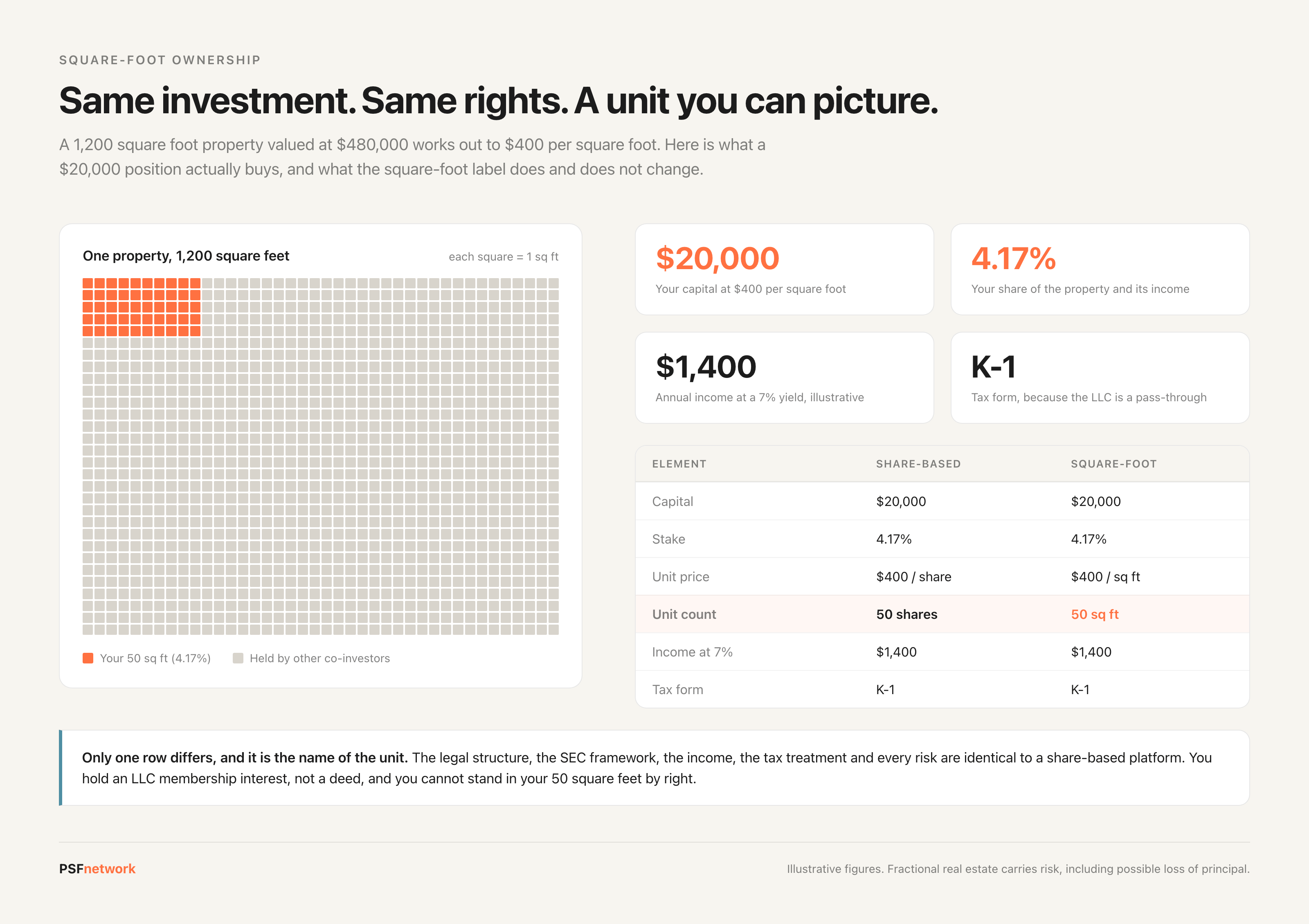
The arithmetic is plain. If a property is 1,200 square feet and the platform values it at $480,000, the per-square-foot price is $400. A 50 square foot purchase costs $20,000 and represents 4.17 percent of the property. The math is identical to buying 50 shares of an equivalent share-based offering at $400 per share. The units just carry a physical anchor, which is what makes psf real estate investing feel different even though the security underneath is the same.
How does the math differ from share-based fractional?
Structurally, it does not. A $20,000 stake in a $480,000 property gives you 4.17 percent of the property and its income whether the unit of ownership is called a share or a square foot. What changes is which number is easier to track in your head. Square feet give you a tangible unit and an intuitive relationship to property size. Shares give you abstract units and ask you to do the math against the property's total share count before you understand your stake.
Here is the same 4.17 percent stake of a $480,000, 1,200 square foot property, side by side.
Element | Share-based | Square-foot |
|---|---|---|
Capital | $20,000 | $20,000 |
Stake percentage | 4.17% | 4.17% |
Unit count | 50 shares (if shares are $400) | 50 sq ft |
Unit price | $400 per share | $400 per sq ft |
Annual income at 7% yield | $1,400 | $1,400 |
Tax form | K-1 | K-1 |
The columns are identical except for unit naming. Same income, same tax form, same regulatory framework, same risks. Anyone weighing fractional ownership square foot models against share-based ones is choosing a label, not a different asset.
What stays the same compared to share-based fractional?
Almost everything. The legal structure (an LLC), the security (a membership interest), the SEC framework (Regulation A or Regulation D), the tax form (Schedule K-1 for pass-through entities), the income mechanism (a proportional share of net rental income and any appreciation), the typical hold period (5 to 10 years), the liquidity profile (a limited secondary market), and the risk profile (loss of principal possible, illiquidity, platform risk) are all identical to share-based fractional platforms. The square-foot model does not give you legal access to the physical square feet you "own."
You are still a member of an LLC, not a deed holder. You cannot walk into a property and stand in your 50 square feet by right. You can do exactly what any other fractional LLC member can do: receive distributions, receive a K-1 at tax time, vote on whatever matters the operating agreement gives members a vote on, and exit when the property is sold or through any secondary market the platform provides.
The same risk disclosures apply. Past performance does not predict future results. Returns are not guaranteed. The investment is not FDIC insured.
What actually changes with square-foot ownership?
Three things change, and none of them is structural. The unit name changes (square feet rather than shares). The mental model changes (a physical anchor rather than an abstract count). And price discoverability changes, because per-square-foot pricing makes valuation comparison more natural across markets. The shift in mental model is the most consequential. Investors who think geographically and physically, in square feet and neighborhoods and building types, tend to find the per-square-foot framing easier. Investors who think financially, in basis points and yield spreads and position sizing, tend to find shares more familiar.
The per-square-foot price also makes cross-market comparison quicker. "Property A is $400 per square foot and Property B is $600 per square foot" is a fast read for anyone who has shopped for real estate. "Property A's shares cost $400 each and Property B's shares cost $600 each" tells you almost nothing until you look up each property's share count. For a platform that pitches itself to investors who think about real estate the way real estate buyers do, square foot fractional investing is a coherent choice rather than a gimmick.
Does square-foot ownership change risk or returns?
No. Returns come from rental income and property appreciation, not from the unit naming. Risk comes from property-specific factors like vacancy, market moves, and repair costs, from platform risk because the operator can fail, from illiquidity across a multi-year hold, and from concentration in any single property. Square-foot ownership is exposed to all of these in exactly the same way share-based ownership is.
If anything, that equivalence is the most important fact about the model. Treat a per-square-foot offering with the same due diligence you would apply to any Reg A fractional property. Pull the offering circular, read the risk factors in full, check the fee schedule, and verify the SEC filing on EDGAR. The presentation does not affect the substance, and the substance is what matters for your portfolio.
When does square-foot ownership make more sense than shares?
Square-foot ownership tends to suit investors who already think in real-estate-market terms, who care about total square footage as a major input to their evaluation, and who want to compare per-square-foot economics across several holdings. Shares tend to suit investors who think financially and want consistent unit pricing across very different properties, or whose existing real estate exposure already runs through REITs and ETFs.
If you are weighing several fractional platforms and the structural fit is otherwise equal, the unit model is a tiebreaker on preference, not a marker of quality. A fractional ownership square foot offering and a share-based one can each be an excellent investment or a poor one, depending on the underlying property, the platform's underwriting, and how well the hold horizon matches your own.
Square foot real estate ownership is best understood as a translation layer, not a new asset. It takes the same Reg A LLC fractional investment that platforms have offered for years and re-expresses your stake in a unit you can actually picture. The legal structure, the K-1, the SEC oversight, the multi-year hold, and the real risk of losing principal all carry over unchanged. What you gain is intuition, a way to see your ownership as a slice of a real building rather than a line of share count, and a per-square-foot price that makes comparing properties across markets faster. That is a genuine benefit for the right investor, but it is a benefit of framing, not of returns. The smart way to use the model is to look straight past the unit label and judge the thing underneath: the property, the platform's underwriting, the fees, and the fit with your timeline. If per square foot ownership helps you understand what you hold, it has done its job. Just hold it to the same standard you would hold any other fractional offering, because underneath the square feet, that is exactly what it is.
Sources:
SEC Office of Investor Education (investor.gov), "Regulation A", https://www.investor.gov/introduction-investing/investing-basics/glossary/regulation-a
SEC Office of Investor Education (investor.gov), "Real Estate Investment Trusts (REITs)", https://www.investor.gov/introduction-investing/investing-basics/investment-products/real-estate-investment-trusts-reits
Internal Revenue Service, "About Schedule K-1 (Form 1065)", https://www.irs.gov/instructions/i1065sk1
See how per-square-foot ownership works on a real property ›
PSFnetwork's offerings are made only under qualified offering documents. Review the offering circular and risk factors before you invest. All investments involve risk, including the possible loss of principal.
Disclaimer: This article is for educational purposes only and does not constitute financial, investment, legal, or tax advice. PSFnetwork investments involve risk, including potential loss of principal. Past performance does not guarantee future returns. Investments are offered through PSF Capital LLC under Reg A+ exemptions. Please review the offering circular and consult a qualified financial advisor before making investment decisions.
Picture owning 50 square feet of a 1,200 square foot apartment that rents every month. Now picture owning 50 shares of the same apartment. The first is something you can see in your head; the second is a number you have to decode. That gap is the entire idea behind square foot real estate ownership, and it is almost the only thing the model actually changes.
Quick Answer (60 seconds)
Square foot real estate ownership expresses your stake in a property as a number of square feet rather than abstract shares. The underlying legal structure is the same as standard fractional platforms: an LLC holds the property and you hold a membership interest in that LLC, a security regulated under SEC Regulation A or Regulation D. Per square foot ownership does not change risk, returns, or tax treatment. What it changes is intuition. Most people can picture 50 square feet of a property; most people cannot picture 50 abstract shares of the same property. The first is tangible, and that is the whole pitch behind psf real estate investing.
Quick numbers (illustrative):
50 sq ft: a typical small position at a $300 per square foot price point
$250 per square foot: an illustrative property price
LLC: the underlying legal structure, the same as share-based platforms
Reg A: the typical SEC filing framework
Square-foot ownership carries the same risks as any fractional real estate investment, including possible loss of principal.
The square-foot model is a presentation choice, not a legal innovation. Underneath, you are buying the same thing you would buy on a share-based fractional platform, a unit of membership interest in an LLC that holds title to a specific property. The legal documents, the SEC filings, the tax forms, and the risk factors are all the same. What the model changes is what you can picture. "I own 50 shares of a rental property" is abstract. "I own 50 square feet of a 1,200 square foot apartment that rents for a set amount each month" is concrete. For some investors that anchoring matters, and for others it does not. The rest of this guide explains the model precisely so you can decide which camp you are in.
What is square-foot real estate ownership?
Square foot real estate ownership is a fractional-investing model that expresses your stake in a property as a number of square feet rather than as shares. You buy a membership interest in an LLC that owns the property, and the LLC denominates ownership in square feet so the math anchors to the physical building. Legally, you hold a security regulated under SEC Regulation A or Regulation D, the same as any other fractional real estate platform.
The model is recent. It emerged as a presentation layer on top of the standard Reg A LLC structures that platforms like Fundrise, Arrived, Ark7, and Realbricks already use. PSFnetwork is the most prominent platform offering per square foot ownership as its default unit. The square-foot model does not require any change to securities law or to LLC operating agreements. It is a naming and pricing convention.
The arithmetic is plain. If a property is 1,200 square feet and the platform values it at $480,000, the per-square-foot price is $400. A 50 square foot purchase costs $20,000 and represents 4.17 percent of the property. The math is identical to buying 50 shares of an equivalent share-based offering at $400 per share. The units just carry a physical anchor, which is what makes psf real estate investing feel different even though the security underneath is the same.
How does the math differ from share-based fractional?
Structurally, it does not. A $20,000 stake in a $480,000 property gives you 4.17 percent of the property and its income whether the unit of ownership is called a share or a square foot. What changes is which number is easier to track in your head. Square feet give you a tangible unit and an intuitive relationship to property size. Shares give you abstract units and ask you to do the math against the property's total share count before you understand your stake.
Here is the same 4.17 percent stake of a $480,000, 1,200 square foot property, side by side.
Element | Share-based | Square-foot |
|---|---|---|
Capital | $20,000 | $20,000 |
Stake percentage | 4.17% | 4.17% |
Unit count | 50 shares (if shares are $400) | 50 sq ft |
Unit price | $400 per share | $400 per sq ft |
Annual income at 7% yield | $1,400 | $1,400 |
Tax form | K-1 | K-1 |
The columns are identical except for unit naming. Same income, same tax form, same regulatory framework, same risks. Anyone weighing fractional ownership square foot models against share-based ones is choosing a label, not a different asset.
What stays the same compared to share-based fractional?
Almost everything. The legal structure (an LLC), the security (a membership interest), the SEC framework (Regulation A or Regulation D), the tax form (Schedule K-1 for pass-through entities), the income mechanism (a proportional share of net rental income and any appreciation), the typical hold period (5 to 10 years), the liquidity profile (a limited secondary market), and the risk profile (loss of principal possible, illiquidity, platform risk) are all identical to share-based fractional platforms. The square-foot model does not give you legal access to the physical square feet you "own."
You are still a member of an LLC, not a deed holder. You cannot walk into a property and stand in your 50 square feet by right. You can do exactly what any other fractional LLC member can do: receive distributions, receive a K-1 at tax time, vote on whatever matters the operating agreement gives members a vote on, and exit when the property is sold or through any secondary market the platform provides.
The same risk disclosures apply. Past performance does not predict future results. Returns are not guaranteed. The investment is not FDIC insured.
What actually changes with square-foot ownership?
Three things change, and none of them is structural. The unit name changes (square feet rather than shares). The mental model changes (a physical anchor rather than an abstract count). And price discoverability changes, because per-square-foot pricing makes valuation comparison more natural across markets. The shift in mental model is the most consequential. Investors who think geographically and physically, in square feet and neighborhoods and building types, tend to find the per-square-foot framing easier. Investors who think financially, in basis points and yield spreads and position sizing, tend to find shares more familiar.
The per-square-foot price also makes cross-market comparison quicker. "Property A is $400 per square foot and Property B is $600 per square foot" is a fast read for anyone who has shopped for real estate. "Property A's shares cost $400 each and Property B's shares cost $600 each" tells you almost nothing until you look up each property's share count. For a platform that pitches itself to investors who think about real estate the way real estate buyers do, square foot fractional investing is a coherent choice rather than a gimmick.
Does square-foot ownership change risk or returns?
No. Returns come from rental income and property appreciation, not from the unit naming. Risk comes from property-specific factors like vacancy, market moves, and repair costs, from platform risk because the operator can fail, from illiquidity across a multi-year hold, and from concentration in any single property. Square-foot ownership is exposed to all of these in exactly the same way share-based ownership is.
If anything, that equivalence is the most important fact about the model. Treat a per-square-foot offering with the same due diligence you would apply to any Reg A fractional property. Pull the offering circular, read the risk factors in full, check the fee schedule, and verify the SEC filing on EDGAR. The presentation does not affect the substance, and the substance is what matters for your portfolio.
When does square-foot ownership make more sense than shares?
Square-foot ownership tends to suit investors who already think in real-estate-market terms, who care about total square footage as a major input to their evaluation, and who want to compare per-square-foot economics across several holdings. Shares tend to suit investors who think financially and want consistent unit pricing across very different properties, or whose existing real estate exposure already runs through REITs and ETFs.
If you are weighing several fractional platforms and the structural fit is otherwise equal, the unit model is a tiebreaker on preference, not a marker of quality. A fractional ownership square foot offering and a share-based one can each be an excellent investment or a poor one, depending on the underlying property, the platform's underwriting, and how well the hold horizon matches your own.
Square foot real estate ownership is best understood as a translation layer, not a new asset. It takes the same Reg A LLC fractional investment that platforms have offered for years and re-expresses your stake in a unit you can actually picture. The legal structure, the K-1, the SEC oversight, the multi-year hold, and the real risk of losing principal all carry over unchanged. What you gain is intuition, a way to see your ownership as a slice of a real building rather than a line of share count, and a per-square-foot price that makes comparing properties across markets faster. That is a genuine benefit for the right investor, but it is a benefit of framing, not of returns. The smart way to use the model is to look straight past the unit label and judge the thing underneath: the property, the platform's underwriting, the fees, and the fit with your timeline. If per square foot ownership helps you understand what you hold, it has done its job. Just hold it to the same standard you would hold any other fractional offering, because underneath the square feet, that is exactly what it is.
Sources:
SEC Office of Investor Education (investor.gov), "Regulation A", https://www.investor.gov/introduction-investing/investing-basics/glossary/regulation-a
SEC Office of Investor Education (investor.gov), "Real Estate Investment Trusts (REITs)", https://www.investor.gov/introduction-investing/investing-basics/investment-products/real-estate-investment-trusts-reits
Internal Revenue Service, "About Schedule K-1 (Form 1065)", https://www.irs.gov/instructions/i1065sk1
See how per-square-foot ownership works on a real property ›
PSFnetwork's offerings are made only under qualified offering documents. Review the offering circular and risk factors before you invest. All investments involve risk, including the possible loss of principal.
Disclaimer: This article is for educational purposes only and does not constitute financial, investment, legal, or tax advice. PSFnetwork investments involve risk, including potential loss of principal. Past performance does not guarantee future returns. Investments are offered through PSF Capital LLC under Reg A+ exemptions. Please review the offering circular and consult a qualified financial advisor before making investment decisions.
Sources
Omar Elghazaly
CEO, PSFnetwork
Disclaimer: This article is for educational purposes only and does not constitute financial, investment, legal, or tax advice. Investments involve risk, including potential loss of principal. Past performance does not guarantee future returns. Investments are offered through PSFnetwork MasterSeries LLC under Reg A. Please review the offering circular and consult a qualified financial advisor before making investment decisions.

Ready when you are
Start from square one
Browse fractional properties across US metros. No accreditation required.
Browse fractional properties across US metros. No accreditation required.

PSFnetwork is in pre-launch. No money or other consideration is being solicited, and if sent, will not be accepted. No offer to buy securities is being made, and no sale will occur until an offering statement filed with the U.S. Securities and Exchange Commission is qualified. Any indication of interest is non-binding, involves no obligation, and may be withdrawn at any time. Any offering will be made only by means of an offering circular.
Investments offered through the Platform involve substantial risk, including the possible loss of principal. Real estate investments are speculative, illiquid, and may not be suitable for all investors. There is currently no established public trading market for the securities offered through the Platform, and one may never develop. Investors may be unable to resell or otherwise liquidate their investment and should be prepared to hold their investment for an indefinite period of time.
References throughout the Platform to investing “by the square foot” or similar terminology are intended solely as branding and investment-sizing concepts. Investors are not acquiring direct deeded ownership of physical real estate or specific square footage within a property. Investments are made through interests in entities associated with underlying real estate assets, as further described in the applicable offering materials.
There can be no assurance that any investment objectives will be achieved or that investors will receive any return of capital. Past performance and historical market data do not guarantee future results. Any market, property, or investment information presented is for informational and educational purposes only and should not be interpreted as a prediction or guarantee of future performance. Nothing on this website constitutes investment, legal, tax, or financial advice.
Properties, pricing, square-foot allocations, yield figures, income examples, calculator outputs, platform functionality, timelines, investor demand, funding expectations, closing outcomes, and platform visuals are illustrative only, subject to change, and may not represent actual offerings or results. Actual results may differ materially and are not guaranteed.
“The Drop” is a promotional giveaway separate from any securities offering. No purchase, investment, or payment is required to enter or win and will not increase the chances of winning. Open only to eligible participants and subject to official rules and applicable law. Void where prohibited.
Any offering will be made solely pursuant to the applicable offering statement, offering circular, subscription agreement, and related offering documents, which should be reviewed carefully, including the risk factors contained therein, prior to making any investment decision.
Broker-dealer services in connection with offerings available through the Platform are provided by Rialto Markets LLC, member FINRA/SIPC.
Neither the Securities and Exchange Commission nor any state securities commission has approved or disapproved of any securities or determined whether this information is accurate or complete.
© 2026 PSFnetwork. All rights reserved.
PSFnetwork is in pre-launch. No money or other consideration is being solicited, and if sent, will not be accepted. No offer to buy securities is being made, and no sale will occur until an offering statement filed with the U.S. Securities and Exchange Commission is qualified. Any indication of interest is non-binding, involves no obligation, and may be withdrawn at any time. Any offering will be made only by means of an offering circular.
Investments offered through the Platform involve substantial risk, including the possible loss of principal. Real estate investments are speculative, illiquid, and may not be suitable for all investors. There is currently no established public trading market for the securities offered through the Platform, and one may never develop. Investors may be unable to resell or otherwise liquidate their investment and should be prepared to hold their investment for an indefinite period of time.
References throughout the Platform to investing “by the square foot” or similar terminology are intended solely as branding and investment-sizing concepts. Investors are not acquiring direct deeded ownership of physical real estate or specific square footage within a property. Investments are made through interests in entities associated with underlying real estate assets, as further described in the applicable offering materials.
There can be no assurance that any investment objectives will be achieved or that investors will receive any return of capital. Past performance and historical market data do not guarantee future results. Any market, property, or investment information presented is for informational and educational purposes only and should not be interpreted as a prediction or guarantee of future performance. Nothing on this website constitutes investment, legal, tax, or financial advice.
Properties, pricing, square-foot allocations, yield figures, income examples, calculator outputs, platform functionality, timelines, investor demand, funding expectations, closing outcomes, and platform visuals are illustrative only, subject to change, and may not represent actual offerings or results. Actual results may differ materially and are not guaranteed.
“The Drop” is a promotional giveaway separate from any securities offering. No purchase, investment, or payment is required to enter or win and will not increase the chances of winning. Open only to eligible participants and subject to official rules and applicable law. Void where prohibited.
Any offering will be made solely pursuant to the applicable offering statement, offering circular, subscription agreement, and related offering documents, which should be reviewed carefully, including the risk factors contained therein, prior to making any investment decision.
Broker-dealer services in connection with offerings available through the Platform are provided by Rialto Markets LLC, member FINRA/SIPC.
Neither the Securities and Exchange Commission nor any state securities commission has approved or disapproved of any securities or determined whether this information is accurate or complete.
© 2026 PSFnetwork. All rights reserved.