Real Estate Crowdfunding vs Fractional Real Estate: Are They the Same?
Real Estate Crowdfunding vs Fractional Real Estate: Are They the Same?
Real Estate Crowdfunding vs Fractional Real Estate: Are They the Same?
The terms get used interchangeably in marketing copy. Structurally they overlap, but they are not the same. Here is what is actually different and what matters for your portfolio.
The terms get used interchangeably in marketing copy. Structurally they overlap, but they are not the same. Here is what is actually different and what matters for your portfolio.
The terms get used interchangeably in marketing copy. Structurally they overlap, but they are not the same. Here is what is actually different and what matters for your portfolio.


Omar Elghazaly
CEO, PSFnetwork
TL;DR
Plenty of people use "real estate crowdfunding" and "fractional real estate" as if they mean the same thing. They don't. The confusion is understandable, because both let you put a small amount of money into property and skip the full mortgage. But the way you own your slice, the rules that govern it, and what you actually hold at the end are different in ways that matter.
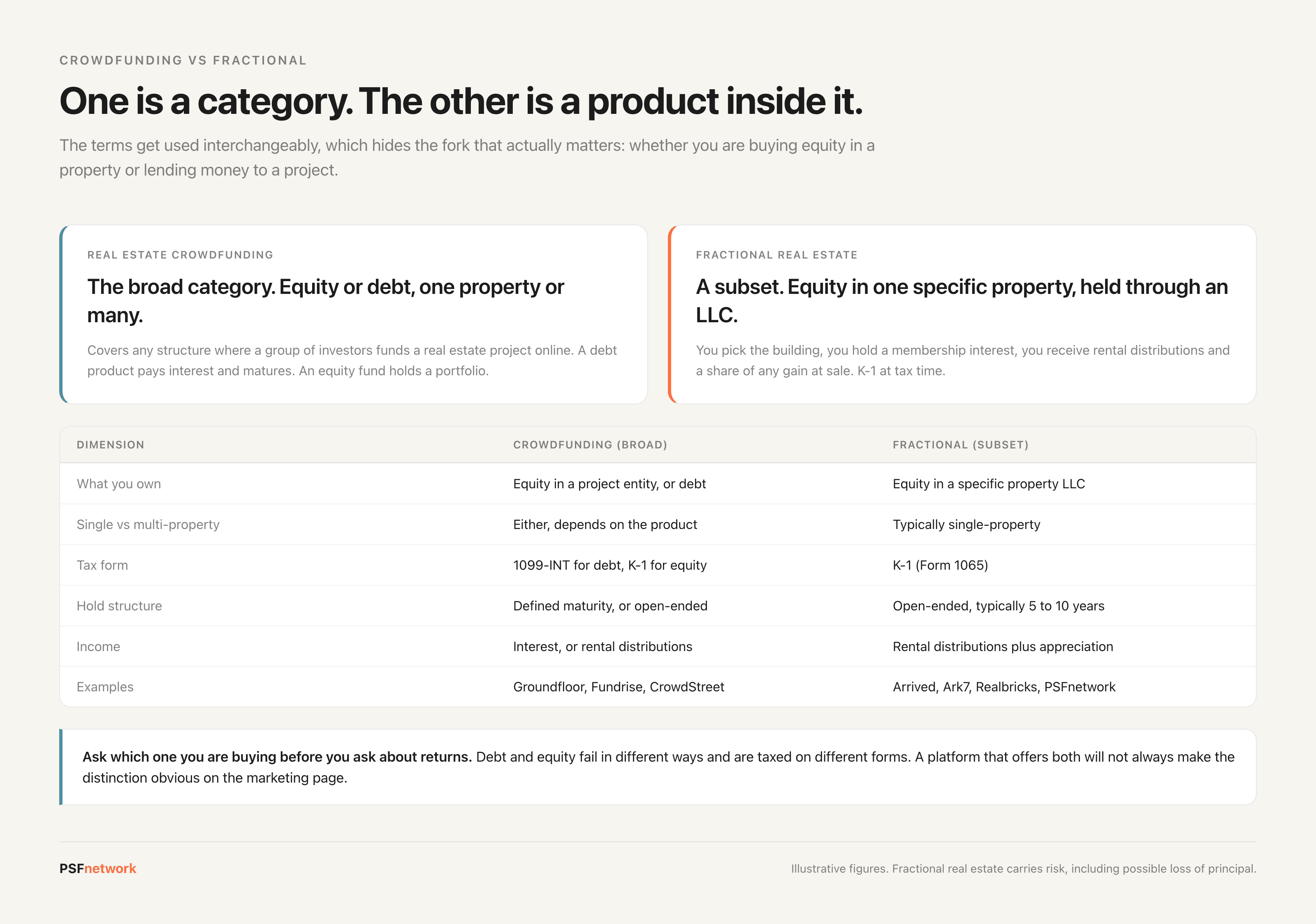
Real estate crowdfunding usually means pooling your money with other investors to fund a property or a portfolio, often through a fund structure. You typically own a share of an entity, not a specific piece of a building.
Fractional real estate means you own a defined fraction of one identified property. Your stake is tied to that asset, not spread across a pool.
They can overlap, and the same platform may offer both. But the words describe different things, and the legal framework behind each offering changes who can invest, how much can be raised, and how easily you can sell.
What Is Real Estate Crowdfunding?
Crowdfunding is a funding method. Many investors each contribute a relatively small amount, and together they fund a larger project. In real estate, that project might be an apartment building, a development, or a pooled fund holding several properties.
Most crowdfunded real estate in the United States runs under one of a few SEC exemptions. One common path is Regulation Crowdfunding, often shortened to Reg CF. Under Reg CF, a company can raise up to $5 million in a 12-month period, and the offering is open to non-accredited investors, meaning everyday people who do not meet high income or net worth thresholds (investor.gov; sec.gov).
The catch with Reg CF is that per-investor limits apply. How much you can put in depends on your income and net worth. Accredited investors, by contrast, have no Reg CF cap.
What do you actually own in a crowdfunding deal? Usually a security issued by an entity, such as shares in a fund or an LLC interest. You are an investor in the structure that holds the property, rather than a direct owner of the bricks.
What Is Fractional Real Estate?
Fractional real estate is about ownership type. You buy a fraction of a single, identified property. Your stake points to that specific asset.
This model has grown in popularity because the barrier to traditional ownership keeps climbing. As of June 2024, the typical down payment on a U.S. home was 18.6%, or about $67,500 (Yahoo Finance). For many people, that figure alone puts a full property out of reach. Fractional ownership lets you hold a piece of a property for far less.
Some fractional offerings use Regulation A, an SEC framework built for raising money from the general public. Regulation A has two tiers. Tier 1 allows up to $20 million per 12-month period, and Tier 2 allows up to $75 million per 12-month period (sec.gov). Both accredited and non-accredited investors can take part in Regulation A offerings, which is a key reason the model has opened up to a broader audience.
Where PSFnetwork Fits
PSFnetwork is a fractional real estate platform built on Regulation A. That structure means both accredited and non-accredited investors can participate.
What sets it apart is how ownership is measured: per square foot, tied to a specific property. You are not buying a vague share of a large pool. You hold a defined fraction of one identified building. The properties on PSFnetwork are mortgage-free and income-oriented, which means there is no loan sitting between you and the asset.
It is worth being clear about what PSFnetwork is not. It is not a forum or a discussion community. It is a platform for owning fractions of real property.
Crowdfunding vs Fractional: The Key Differences
Here is how the two stack up side by side. Keep in mind that any platform may structure its offerings differently, so always read the specific terms.
Feature | Real Estate Crowdfunding | Fractional Real Estate |
|---|---|---|
What it describes | A funding method (pooling capital) | An ownership type (a defined slice of one asset) |
What you own | A share of an entity or fund | A fraction of a specific, identified property |
Common regulation | Often Regulation Crowdfunding (Reg CF) | Often Regulation A (Tier 1 or Tier 2) |
Annual raise limit | Up to $5M per 12 months under Reg CF (sec.gov) | Up to $20M (Tier 1) or $75M (Tier 2) per 12 months (sec.gov) |
Investor access | Reg CF open to non-accredited, with per-investor limits (investor.gov) | Reg A open to both accredited and non-accredited investors (sec.gov) |
Property link | Often pooled across multiple assets | Tied to one specific property |
Typical minimums | Varies by platform, often low | Varies by platform, often low |
Liquidity | Generally limited; private holdings can be hard to sell quickly | Generally limited; resale depends on the platform and a secondary market |
The biggest takeaway from this table: crowdfunding answers how the money is gathered, while fractional answers what you hold. A deal can be both at once.
A Quick Note on Risk and Returns
Private real estate is not a sure thing. Returns are not guaranteed, and any yields you see quoted are platform-reported and may vary. Property values can fall. Historical performance does not predict future results.
Liquidity is another point to weigh. Unlike a publicly traded stock, a fractional or crowdfunded stake can be hard to sell on short notice. Read each offering's terms so you understand how, and whether, you can exit.
As a result; crowdfunding and fractional real estate are not interchangeable, even though they often share a sign-up page. One is a method for raising money. The other is a way of owning property. The regulation behind each offering shapes who can invest and how much can be raised: Reg CF caps a raise at $5 million a year and is open to non-accredited investors with limits, while Regulation A allows up to $75 million a year under Tier 2 and welcomes both investor types (sec.gov; investor.gov).
If you want a stake tied to a single, identified property rather than a broad pool, fractional ownership is the model to look at. PSFnetwork applies that approach through Regulation A, measuring ownership per square foot on mortgage-free, income-oriented properties, and keeping the door open to both accredited and non-accredited investors. Whichever route you explore, read the terms, understand the liquidity, and remember that returns are never guaranteed.
Sources
U.S. Securities and Exchange Commission, Regulation Crowdfunding: https://www.sec.gov/resources-small-businesses/exempt-offerings/regulation-crowdfunding
Investor.gov, Regulation Crowdfunding: https://www.investor.gov/introduction-investing/investing-basics/glossary/regulation-crowdfunding
U.S. Securities and Exchange Commission, Regulation A: https://www.sec.gov/resources-small-businesses/exempt-offerings/regulation
Yahoo Finance, average down payment on a house (June 2024 figure): https://finance.yahoo.com/personal-finance/mortgages/article/average-down-payment-on-a-house-182153085.html
Real estate crowdfunding usually means pooling your money with other investors to fund a property or a portfolio, often through a fund structure. You typically own a share of an entity, not a specific piece of a building.
Fractional real estate means you own a defined fraction of one identified property. Your stake is tied to that asset, not spread across a pool.
They can overlap, and the same platform may offer both. But the words describe different things, and the legal framework behind each offering changes who can invest, how much can be raised, and how easily you can sell.
What Is Real Estate Crowdfunding?
Crowdfunding is a funding method. Many investors each contribute a relatively small amount, and together they fund a larger project. In real estate, that project might be an apartment building, a development, or a pooled fund holding several properties.
Most crowdfunded real estate in the United States runs under one of a few SEC exemptions. One common path is Regulation Crowdfunding, often shortened to Reg CF. Under Reg CF, a company can raise up to $5 million in a 12-month period, and the offering is open to non-accredited investors, meaning everyday people who do not meet high income or net worth thresholds (investor.gov; sec.gov).
The catch with Reg CF is that per-investor limits apply. How much you can put in depends on your income and net worth. Accredited investors, by contrast, have no Reg CF cap.
What do you actually own in a crowdfunding deal? Usually a security issued by an entity, such as shares in a fund or an LLC interest. You are an investor in the structure that holds the property, rather than a direct owner of the bricks.
What Is Fractional Real Estate?
Fractional real estate is about ownership type. You buy a fraction of a single, identified property. Your stake points to that specific asset.
This model has grown in popularity because the barrier to traditional ownership keeps climbing. As of June 2024, the typical down payment on a U.S. home was 18.6%, or about $67,500 (Yahoo Finance). For many people, that figure alone puts a full property out of reach. Fractional ownership lets you hold a piece of a property for far less.
Some fractional offerings use Regulation A, an SEC framework built for raising money from the general public. Regulation A has two tiers. Tier 1 allows up to $20 million per 12-month period, and Tier 2 allows up to $75 million per 12-month period (sec.gov). Both accredited and non-accredited investors can take part in Regulation A offerings, which is a key reason the model has opened up to a broader audience.
Where PSFnetwork Fits
PSFnetwork is a fractional real estate platform built on Regulation A. That structure means both accredited and non-accredited investors can participate.
What sets it apart is how ownership is measured: per square foot, tied to a specific property. You are not buying a vague share of a large pool. You hold a defined fraction of one identified building. The properties on PSFnetwork are mortgage-free and income-oriented, which means there is no loan sitting between you and the asset.
It is worth being clear about what PSFnetwork is not. It is not a forum or a discussion community. It is a platform for owning fractions of real property.
Crowdfunding vs Fractional: The Key Differences
Here is how the two stack up side by side. Keep in mind that any platform may structure its offerings differently, so always read the specific terms.
Feature | Real Estate Crowdfunding | Fractional Real Estate |
|---|---|---|
What it describes | A funding method (pooling capital) | An ownership type (a defined slice of one asset) |
What you own | A share of an entity or fund | A fraction of a specific, identified property |
Common regulation | Often Regulation Crowdfunding (Reg CF) | Often Regulation A (Tier 1 or Tier 2) |
Annual raise limit | Up to $5M per 12 months under Reg CF (sec.gov) | Up to $20M (Tier 1) or $75M (Tier 2) per 12 months (sec.gov) |
Investor access | Reg CF open to non-accredited, with per-investor limits (investor.gov) | Reg A open to both accredited and non-accredited investors (sec.gov) |
Property link | Often pooled across multiple assets | Tied to one specific property |
Typical minimums | Varies by platform, often low | Varies by platform, often low |
Liquidity | Generally limited; private holdings can be hard to sell quickly | Generally limited; resale depends on the platform and a secondary market |
The biggest takeaway from this table: crowdfunding answers how the money is gathered, while fractional answers what you hold. A deal can be both at once.
A Quick Note on Risk and Returns
Private real estate is not a sure thing. Returns are not guaranteed, and any yields you see quoted are platform-reported and may vary. Property values can fall. Historical performance does not predict future results.
Liquidity is another point to weigh. Unlike a publicly traded stock, a fractional or crowdfunded stake can be hard to sell on short notice. Read each offering's terms so you understand how, and whether, you can exit.
As a result; crowdfunding and fractional real estate are not interchangeable, even though they often share a sign-up page. One is a method for raising money. The other is a way of owning property. The regulation behind each offering shapes who can invest and how much can be raised: Reg CF caps a raise at $5 million a year and is open to non-accredited investors with limits, while Regulation A allows up to $75 million a year under Tier 2 and welcomes both investor types (sec.gov; investor.gov).
If you want a stake tied to a single, identified property rather than a broad pool, fractional ownership is the model to look at. PSFnetwork applies that approach through Regulation A, measuring ownership per square foot on mortgage-free, income-oriented properties, and keeping the door open to both accredited and non-accredited investors. Whichever route you explore, read the terms, understand the liquidity, and remember that returns are never guaranteed.
Sources
U.S. Securities and Exchange Commission, Regulation Crowdfunding: https://www.sec.gov/resources-small-businesses/exempt-offerings/regulation-crowdfunding
Investor.gov, Regulation Crowdfunding: https://www.investor.gov/introduction-investing/investing-basics/glossary/regulation-crowdfunding
U.S. Securities and Exchange Commission, Regulation A: https://www.sec.gov/resources-small-businesses/exempt-offerings/regulation
Yahoo Finance, average down payment on a house (June 2024 figure): https://finance.yahoo.com/personal-finance/mortgages/article/average-down-payment-on-a-house-182153085.html
Omar Elghazaly
CEO, PSFnetwork
Disclaimer: This article is for educational purposes only and does not constitute financial, investment, legal, or tax advice. Investments involve risk, including potential loss of principal. Past performance does not guarantee future returns. Investments are offered through PSFnetwork MasterSeries LLC under Reg A. Please review the offering circular and consult a qualified financial advisor before making investment decisions.

Ready when you are
Start from square one
Browse fractional properties across US metros. No accreditation required.
Browse fractional properties across US metros. No accreditation required.

PSFnetwork is in pre-launch. No money or other consideration is being solicited, and if sent, will not be accepted. No offer to buy securities is being made, and no sale will occur until an offering statement filed with the U.S. Securities and Exchange Commission is qualified. Any indication of interest is non-binding, involves no obligation, and may be withdrawn at any time. Any offering will be made only by means of an offering circular.
Investments offered through the Platform involve substantial risk, including the possible loss of principal. Real estate investments are speculative, illiquid, and may not be suitable for all investors. There is currently no established public trading market for the securities offered through the Platform, and one may never develop. Investors may be unable to resell or otherwise liquidate their investment and should be prepared to hold their investment for an indefinite period of time.
References throughout the Platform to investing “by the square foot” or similar terminology are intended solely as branding and investment-sizing concepts. Investors are not acquiring direct deeded ownership of physical real estate or specific square footage within a property. Investments are made through interests in entities associated with underlying real estate assets, as further described in the applicable offering materials.
There can be no assurance that any investment objectives will be achieved or that investors will receive any return of capital. Past performance and historical market data do not guarantee future results. Any market, property, or investment information presented is for informational and educational purposes only and should not be interpreted as a prediction or guarantee of future performance. Nothing on this website constitutes investment, legal, tax, or financial advice.
Properties, pricing, square-foot allocations, yield figures, income examples, calculator outputs, platform functionality, timelines, investor demand, funding expectations, closing outcomes, and platform visuals are illustrative only, subject to change, and may not represent actual offerings or results. Actual results may differ materially and are not guaranteed.
“The Drop” is a promotional giveaway separate from any securities offering. No purchase, investment, or payment is required to enter or win and will not increase the chances of winning. Open only to eligible participants and subject to official rules and applicable law. Void where prohibited.
Any offering will be made solely pursuant to the applicable offering statement, offering circular, subscription agreement, and related offering documents, which should be reviewed carefully, including the risk factors contained therein, prior to making any investment decision.
Broker-dealer services in connection with offerings available through the Platform are provided by Rialto Markets LLC, member FINRA/SIPC.
Neither the Securities and Exchange Commission nor any state securities commission has approved or disapproved of any securities or determined whether this information is accurate or complete.
© 2026 PSFnetwork. All rights reserved.
PSFnetwork is in pre-launch. No money or other consideration is being solicited, and if sent, will not be accepted. No offer to buy securities is being made, and no sale will occur until an offering statement filed with the U.S. Securities and Exchange Commission is qualified. Any indication of interest is non-binding, involves no obligation, and may be withdrawn at any time. Any offering will be made only by means of an offering circular.
Investments offered through the Platform involve substantial risk, including the possible loss of principal. Real estate investments are speculative, illiquid, and may not be suitable for all investors. There is currently no established public trading market for the securities offered through the Platform, and one may never develop. Investors may be unable to resell or otherwise liquidate their investment and should be prepared to hold their investment for an indefinite period of time.
References throughout the Platform to investing “by the square foot” or similar terminology are intended solely as branding and investment-sizing concepts. Investors are not acquiring direct deeded ownership of physical real estate or specific square footage within a property. Investments are made through interests in entities associated with underlying real estate assets, as further described in the applicable offering materials.
There can be no assurance that any investment objectives will be achieved or that investors will receive any return of capital. Past performance and historical market data do not guarantee future results. Any market, property, or investment information presented is for informational and educational purposes only and should not be interpreted as a prediction or guarantee of future performance. Nothing on this website constitutes investment, legal, tax, or financial advice.
Properties, pricing, square-foot allocations, yield figures, income examples, calculator outputs, platform functionality, timelines, investor demand, funding expectations, closing outcomes, and platform visuals are illustrative only, subject to change, and may not represent actual offerings or results. Actual results may differ materially and are not guaranteed.
“The Drop” is a promotional giveaway separate from any securities offering. No purchase, investment, or payment is required to enter or win and will not increase the chances of winning. Open only to eligible participants and subject to official rules and applicable law. Void where prohibited.
Any offering will be made solely pursuant to the applicable offering statement, offering circular, subscription agreement, and related offering documents, which should be reviewed carefully, including the risk factors contained therein, prior to making any investment decision.
Broker-dealer services in connection with offerings available through the Platform are provided by Rialto Markets LLC, member FINRA/SIPC.
Neither the Securities and Exchange Commission nor any state securities commission has approved or disapproved of any securities or determined whether this information is accurate or complete.
© 2026 PSFnetwork. All rights reserved.